
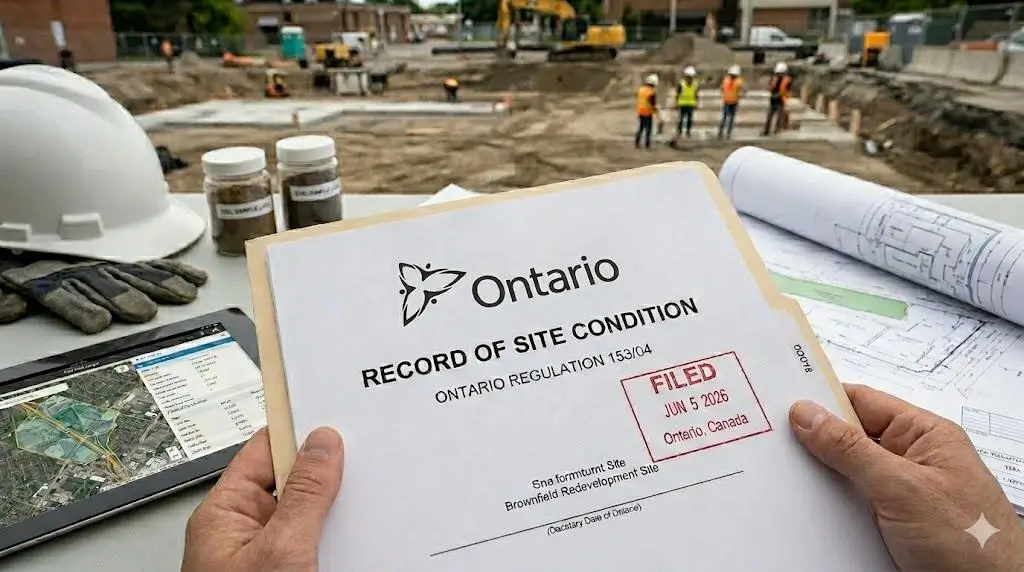
In Ontario, a Record of Site Condition (RSC) is an official legal document filed with the Ministry of the Environment, Conservation and Parks (MECP) that certifies the environmental health of a property. It is governed by Ontario Regulation 153/04.
An RSC summarizes the results of Environmental Site Assessments (ESAs) conducted by a Qualified Person (QP) (a licensed Professional Engineer or Geoscientist). It confirms that the soil and groundwater on the property meet the provincial standards for its intended use.
The process generally involves two main stages:
The RSC is a critical hurdle in Ontario’s real estate and development sector for three primary reasons:
A. Legal Requirement for “Change of Use”
The most common trigger is a change to a more sensitive land use. You cannot legally switch a property’s use from industrial or commercial to residential, institutional (like a school), or parkland without a filed RSC. Municipalities will generally refuse to issue building permits until the RSC appears on the public Environmental Site Registry.
B. Liability Protection
Once an RSC is filed, the property owner (and future owners) receives statutory protection from certain environmental orders. This means the Ministry cannot later order you to clean up contamination that existed before the RSC was filed, provided the filing was accurate.
Note: This protection does not stop third-party lawsuits or cover contamination that migrates off-site.
C. Financing and Risk Management
Banks and lenders almost always require an RSC before providing a mortgage or construction loan for a former industrial site. It provides them with the assurance that the land isn’t a “toxic asset” that would incur massive cleanup costs or legal liabilities.